Choosing the Right Time for a Magical Practice
Choosing the right time for magical practice often hinges on being in the “right place at the right time.” The timing of a ritual can be simple or complex, but it invariably affects the outcome of your work. The immediacy of intention often plays a crucial role in determining the appropriate time. While it’s impractical to wait for an ideal moment when the need is immediate, it’s also important to recognize that certain works may not succeed when natural energies are destructive.
The largest time cycle is the seasonal cycle. Spring corresponds to the element of Air, summer is ruled by Fire, autumn’s element is Water, and winter falls under Earth. While it’s not always feasible to wait for a specific season, this knowledge allows for planning effective seasonal practices.
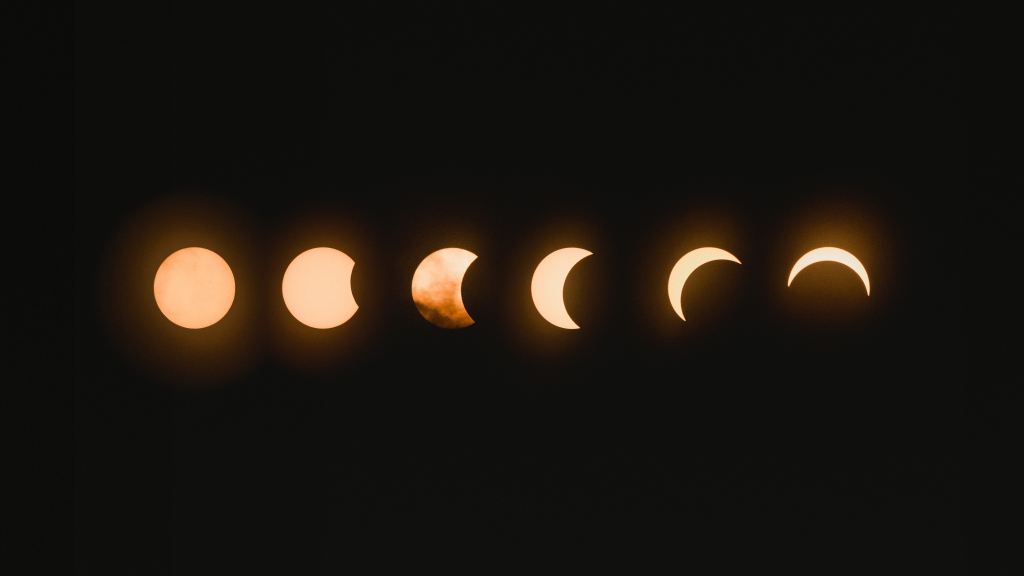
Earth’s energies are also influenced by lunar cycles. A waxing Moon generally signifies an influx and growth of energies. The Full Moon indicates that nature’s forces are currently directed toward materialization and manifestation. This short period of maximum power should be used for the rapid materialization of intentions. The waning Moon signifies a decrease in natural energies, making it a suitable time for practices aimed at eliminating the unnecessary and for energetic cleansing. The New Moon, where the Moon is completely unlit and invisible to the naked eye, favors works related to transformation (as it symbolizes the transition between death and rebirth) and uncovering hidden information.
Practices can also be aligned with the day of the week governed by a specific planet, using traditional correspondences. This approach allows you to tap into the planetary energies that best align with your intentions and the nature of your magical work.

Planetary Governance of the Days of the Week
Choosing the right time for magical practice can often depend on understanding the planetary governance of the days of the week. This ancient method, dating back to Babylonian astrology, uses only the Sun, Moon, and the five planets visible to the naked eye: Mercury, Venus, Mars, Jupiter, and Saturn.
Our modern calendar is based on this ancient system, with each of the seven days corresponding to one of the seven classical planets. Each day is governed by a planet starting from the first hour of dawn, creating a cycle of planetary hours within each day, each with its own unique influence.
For instance, Monday is ruled by the Moon and is associated with the element of Water. This day influences our emotions and the subtle plane. The Moon represents motherhood, family, home, as well as intuition, the subconscious, and the psyche. Monday is ideal for activities related to family and home, and for seeking guidance from lunar deities like Artemis, Diana, Frigg, Isis, etc. It’s a day conducive to meditation, developing intuition, expanding consciousness, and healing practices.
Understanding these planetary influences can significantly enhance the effectiveness of your magical practices by aligning them with the energies of the corresponding day.
Tuesday is the day of Mars and associated war gods. The vibrations of this day are filled with harsh, aggressive energy. It corresponds to the element of fire in its destructive aspect. It’s a good day for active, decisive actions, winning in competition, and achieving goals. Martian energies are most favorable for countering enemies and ill-wishers, active defense, and igniting passion.
Wednesday is governed by Mercury and corresponds to the element of air. In Ancient Rome, Mercury was the god of commerce, crafts, knowledge, writing, and eloquence. Moreover, Hermes-Mercury acted as a mediator between the world of gods and the world of humans, traveling between realms. As such, Wednesday favors communication and negotiations, public speaking, travel, financial transactions, and learning (including occult knowledge), as well as working with information. Notably, Mercury-Hermes, in the guise of the Ancient Egyptian Thoth, is a patron of secret knowledge and also a guardian of Tarot. The magic of Wednesday is associated with the realm of finance and material well-being. It’s a suitable day for opening financial flows and establishing partnerships.
Thursday is governed by Jupiter, often referred to as the “great benefactor” in ancient grimoires. It embodies the energies of power, order, wisdom, authority, justice, and prosperity. Additionally, Jupiter is the planet of society and public life. Therefore, Thursday is the ideal day to realize goals in these areas. Practices aimed at restoring justice, as well as attracting energies of power, rituals for career growth, and material well-being, are appropriate for this day. Jupiter’s influence on Thursday makes it a powerful time for activities that enhance social status and contribute to personal and communal prosperity.
Friday is ruled by Venus, the planet of love, beauty, emotions, and pleasures. In addition to the feminine energies of the planet, Friday also carries the passivity of the earth element. This day is ideal for relaxation, appreciating beauty, and creative self-expression. Friday’s magic primarily focuses on rituals aimed at unveiling femininity, charm, preserving youth and beauty, love magic, and tantric practices.
Saturday falls under the guardianship of Saturn. Its energies are associated with the flow of time, inertia, self-discipline, law, and karma. The day tends to be quite passive. It’s well-suited for spending time alone, meditating, deeply introspecting, and contemplating life’s meaning. In a magical sense, Saturday is suitable for energetic cleansing, protective rituals, working through karma, and meditation.
Sunday is the day of the Sun. The magic of Sunday is associated with bright themes and good intentions. The element of the day is fire, but in its creative aspect. It is a time for rising energy and creative activity. The magic of Sunday is tied to harmonization, healing, and energizing practices: rituals that align with these themes will be very appropriate. Additionally, the magical aspect of Sunday favors planning important matters, attracting energies of success, and prosperity.
Understanding these principles and correspondences can help establish a harmonious existence and interaction with the Universe in accordance with cosmic cycles. Planning based on the energetic characteristics of each day allows not only alignment with the vibrations of the Universe but also helps in choosing favorable times for magical practices and daily activities.
Calculating Planetary Hours: A Revived Ancient Methodology
The method of calculating planetary hours has recently seen a resurgence due to translations of historical texts. Modern astrologers had previously overlooked this planetary time system, possibly because of its symbolic nature, which was considered less scientific compared to the actual daily positions of planets according to precise astronomical calculations. However, practitioners of magic have continued to use planetary hours as they have for centuries, due to both their ease of use and their effectiveness.
The seven primary planets, according to the Chaldean order which arranges them from the slowest to the fastest, also govern the hours of the day in a repeating sequence. The planet that rules the corresponding day also governs the hour of sunrise, and then the next planet in the Chaldean order rules the following hour, continuing in this repeating sequence. This system intertwines the cosmic and earthly realms, allowing for a harmonious alignment of daily activities and magical practices with the rhythmic flow of planetary energies.
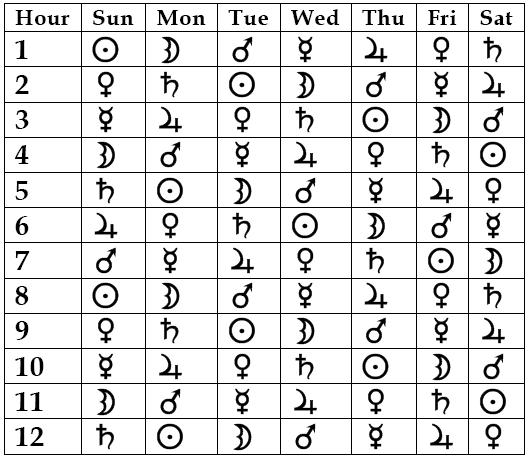
Using planetary hours, it’s important to understand that a planetary “day” is not the same as our calendar days, and an hour does not necessarily contain sixty minutes. Planetary days begin with sunrise, so the hours between midnight and sunrise belong to the previous day. To account for the seasonal difference in the length of daylight, the amount of time in each hour varies day and night. Only on the days of the equinoxes do the hours approximate sixty minutes both day and night. On the day of the summer solstice (the longest day of the year), daytime hours are significantly longer than nighttime hours. On the day of the winter solstice (the longest night of the year), nighttime hours are significantly longer than daytime hours.
You can calculate planetary hours yourself if you know the time of sunrise and sunset in your area. Here’s how you do it:
- Daytime Hours:
- Calculate the total time from sunrise to sunset.
- Divide this total time by 12 to find out the duration of each daytime planetary hour.
- Nighttime Hours:
- Calculate the total time from sunset to the next sunrise.
- Divide this total time by 12 to determine the duration of each nighttime planetary hour.
The length of each planetary hour will vary throughout the year due to changes in the length of days and nights. During equinoxes, when the day and night are approximately equal, each planetary hour will be close to 60 minutes. However, during solstices, the difference will be more pronounced, with longer hours during the day in the summer solstice and longer hours during the night in the winter solstice.
Remember, this method is based on the traditional understanding of planetary hours used in various historical and astrological contexts. It reflects how different cultures have observed and interacted with the natural rhythm of day and night.
Selecting the Right Planetary Hour for Astrological Practices
In the context of natal astrology, each of us is born during a specific “planetary hour,” which can provide crucial insights for the interpretation of a birth chart. In predictive astrology, the Persians used planetary hours as the “lord of the orb” when interpreting the annual solar return for individuals. In horary astrology, special attention is given to the planetary hour at the moment of chart creation to determine if it is “radical” and can provide an accurate answer to our question. In electional astrology, planetary hours can aid in finding the most suitable time for a particular activity.
Choosing the most suitable planetary hour for your planned practice depends on which planet aligns best with your intentions. Most practices can be structured according to traditional symbolism:
- Sun Hour: Favorable for career success, job seeking, promotions, presentations, public speaking, enhancing social status, approaching authorities, strengthening health, and any harmonization activities.
- Moon Hour: Ideal for developing intuition or imagination, for all home-related tasks, improving relationships with family and close people, and working with your subconscious.
- Mercury Hour: Most beneficial for developing abstract thinking, mental activity, communication, signing documents, sending important mail, and activities related to communication, provided you are focused on logic and rationality.
- Venus Hour: Harmonious for attracting love, courtship, marriage, improving appearance, preserving youth and beauty, working with sexuality and femininity, and reconciliation.
- Mars Hour: Suitable for activities that require bravery, courage, and active initiative. Mars can be aggressive and confrontational.
- Jupiter Hour: Great for success in almost any activity you can imagine and for starting something important. The only downside might be a tendency towards excess.
- Saturn Hour: Most favorable for organizing, performing strenuous work, getting rid of unwanted habits, developing self-discipline, and endurance.
Try incorporating planetary hours into your practice! Among astrological methods, this approach is particularly suited for situations where you need to make a quick decision about timing without the ability to perform more complex astrological calculations, even if you know how to do them. Choose the planetary hour that best aligns with the intentions of your planned practices, and carry out your actions with dedication, willpower, focus, and belief in the magic to achieve the most effective results. This method can add an additional layer of depth and intention to your astrological practices, harnessing the unique energies of each planet to optimize the outcomes of your endeavors.



 tea party on the moon
Leave a comment