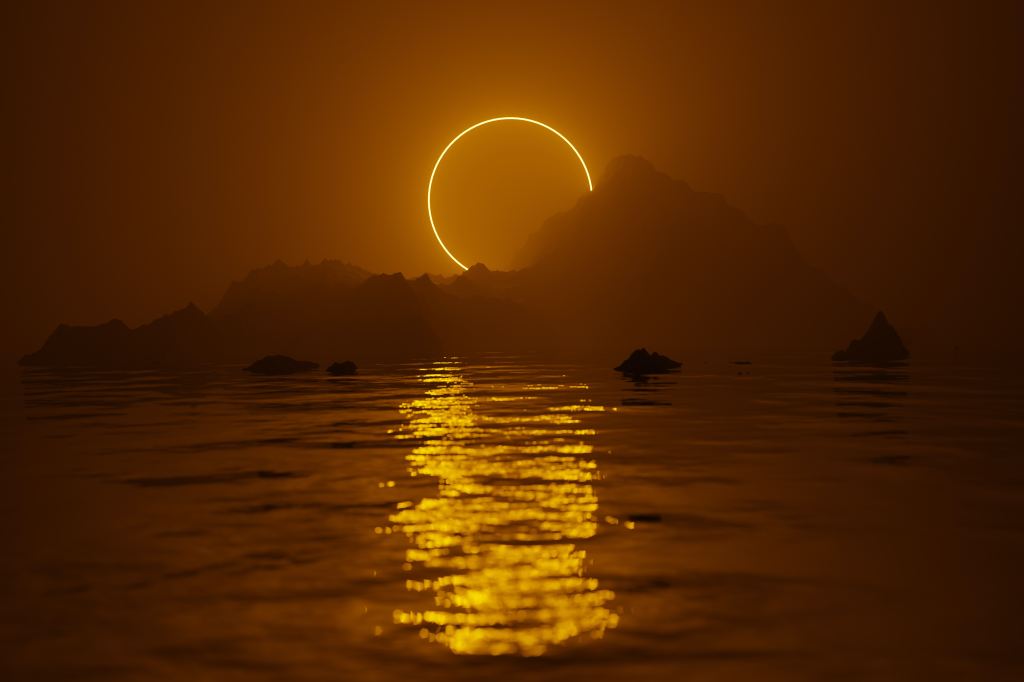
Chinese beliefs hold that the day of a solar eclipse represents a momentary triumph of the feminine principle, Yin, over the masculine, Yang.
What Is Solar Eclipse?
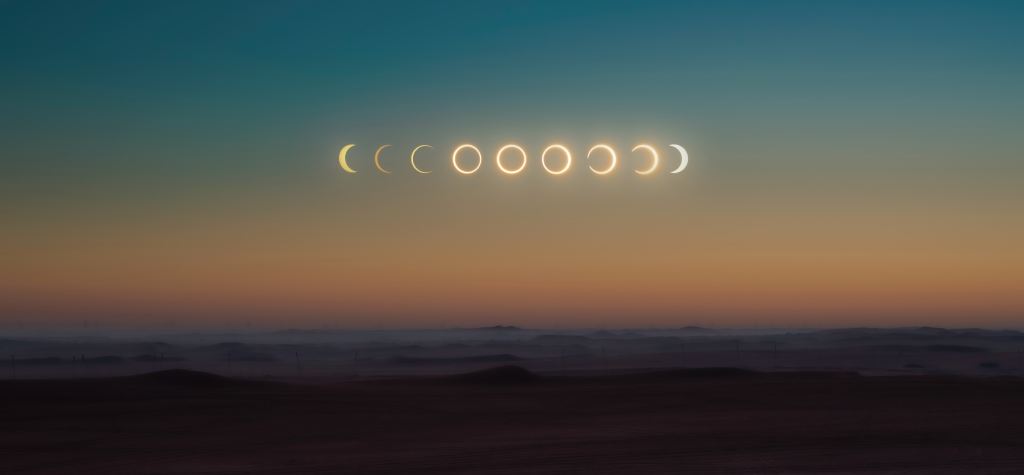
A Solar Eclipse is a complete or partial covering of the Sun by the Moon. This phenomenon occurs exclusively during a new moon when the Moon is not visible from Earth. The extent of the eclipse depends on the orbit of the Earth’s satellite at that moment, which is not always the same. Partial eclipses are more common, while total eclipses are much rarer. Eclipses happen 5-6 times a year, and typically, the maximum coverage of the Sun is about 80%.
Eclipses are not visible from every point on the globe. The end of the lunar shadow’s cone glides across the Earth’s surface, and it is in the areas covered by this shadow that solar eclipses can be observed.
A solar eclipse appears as a shadow creeping over the Sun – sometimes round, but more often crescent-shaped. During an eclipse, it gets darker outside, stars appear, and even planets usually invisible to the naked eye become visible. Around the Sun, a phenomenon known as the solar corona forms. A total solar eclipse can last from a few moments to up to 8 minutes. For any given location on Earth, a total solar eclipse is an extremely rare event, occurring once in a century or even two.
Does a Solar Eclipse Affect Human Psychology?
According to ancient beliefs, eclipses were associated with various negative events such as famine, wars, diseases, natural disasters, and crop failures. People feared eclipses, perceiving them as omens of impending doom. However, ancient astrologers believed that eclipses could occur not only in times of hardship but also during periods of national unity and human prosperity.
Astrologers also believe that eclipses can influence the collective consciousness and trigger emotional responses in many people. For example, solar eclipses may evoke feelings of uncertainty, while lunar eclipses can stir up emotional excitement.
Overall, the time of eclipses is considered a period of change and transition. Although these changes can be both positive and negative, they are always seen as signs of significant events and shifts that can impact our lives and destinies.
Eclipses can also activate the karmic programs of individuals and entire societies, helping to reveal issues that require resolution. A thorough analysis of a horoscope can identify events that are highly likely during an eclipse. When analyzing the impact of eclipses, it’s important to consider the differences in the influence of the Moon and the Sun during these events. Eclipses should not be viewed solely as negative; they can have positive effects on people’s lives.

How Do Lunar and Solar Eclipses Differ?
The differences between lunar and solar eclipses in the context of their impact on humans can be summarized as follows:
- Solar Eclipses typically manifest in the external environment of human endeavors and are associated with attracting significant events from the surrounding reality. They are often linked to the physical and material aspects of life, influencing actions, events, and external changes in one’s life.
- Lunar Eclipses, on the other hand, manifest in the internal environment of an individual and are related to contemplations on life stages, as well as experiencing old/new emotions. A lunar eclipse can activate intuition and a drive towards spiritual practices. It is often perceived as a time for self-analysis and internal processing.
However, it’s important to note that the feelings and thoughts provoked by a lunar eclipse can lead to making new and important decisions in the external spheres of a person’s life. Conversely, events triggered by a solar eclipse can influence a person’s inner world – altering their usual pattern of thinking and introducing new perspectives, emotions, and feelings into their life.
Solar Eclipse: Key Points
- The Sun is associated with masculine principles, spirit, and consciousness, and a solar eclipse is often accompanied by significant events in an individual’s life or a country.
- Solar eclipses occur only during a new moon and can negatively affect living beings, causing a halt in energy flow and a decline in physical condition, as well as confusion in thoughts and reduced perception.
- Men and people engaged in creative pursuits may particularly feel the energy of the eclipse.
- A solar eclipse can create tension in society and exacerbate social conflicts, as well as increase the number of accidents and mishaps.
- Authority figures may lose control and act impulsively during eclipses, which can have long-term negative consequences for the state.
Eclipse from the Perspective of Jyotish Astrology
From the Vedic perspective, both solar and lunar eclipses are generally inauspicious, including for any actions or new ventures (considered an unfavorable ‘muhurta’). However, if the actions are related to a person’s spiritual life or service to God/Absolute, then the time of an eclipse can and should be used for spiritual practice.
During a solar eclipse, the shadow planet Rahu covers the Sun, and since the Sun’s rays are vital for life on Earth and all living beings, the interruption of solar rays is unfavorable. Thus, during solar eclipses, we receive not the light of life from the Sun but the radiation of darkness emanating from Rahu (Rahu is a ‘graha’ [planet], the North Lunar Node, located at the intersection of the Moon’s orbital plane and the ecliptic). The eclipse removes or reduces the solar energy (‘prana’) for the whole Earth, affecting both humans and animals.
During an eclipse, consciousness is overshadowed, and the mind struggles to orient itself in events. Generally, a solar eclipse creates an unfavorable influence on society, increasing tension and supporting destructive tendencies. This influence continues for one year.
According to Jyotish [Vedic astrology] and Vedic traditions, it is recommended to observe certain rules during solar and lunar eclipses:
- Do not look at the eclipse
- Stay indoors (especially avoid travel or journeys) and remain in a closed environment
- Do not eat 3 hours before and after the eclipse
- Drive carefully, if at all
- Avoid financial transactions
- Avoid contact with crowds
- It is recommended to meditate and engage in other spiritual practices (or at least just rest)
- It is advisable to give up harmful habits as the body adapts faster
Doctors know that an eclipse can negatively affect the well-being of even a practically healthy person. The impact of this natural phenomenon on behavior and well-being begins to be felt two weeks before their occurrence. People who are meteorologically sensitive suffer particularly.
Research on eclipses suggests that the likelihood of various types of catastrophes increases during the “sphere of influence of the eclipse.” In the following weeks, events such as intensification of wars, fires, airport disasters, or unusual meteorological phenomena are likely. One of the world leaders may be involved in a scandal or tragedy; influential rulers may be blinded by anger, envy, and ego, leading to illogical or foolish decisions made by world leaders.
Is it Unsafe to Look at the Sun During a Solar Eclipse?
The reason why direct viewing of the sun during a solar eclipse is hazardous is that despite the sun being 150 million kilometers away, it can cause serious and sometimes irreversible eye damage. Even a brief glance at the sun can harm your vision.
To understand why, consider how children use a magnifying glass to burn paper or wood. The concentration of solar rays at a single point results in intense heat. The lenses in our eyes are much more powerful than some magnifying glasses. Therefore, direct exposure to the sun can lead to retinal burns or damage to the light-sensitive cells within the eye.
In examinations of people with such eye damage, known as solar retinopathy, distinctive signs were observed: it appeared as if a thin instrument had dislodged several cells from the light-sensitive area of the retina.
This damage is believed to occur when photons (light particles) create free radicals – highly reactive, unstable molecules that harm healthy cells. The damage takes place in the fovea area. The fovea (Latin: fovea centralis) is a small depression located in the center of the retina’s yellow spot. It corresponds to the approximate rear pole of the eyeball and measures between 0.2 to 0.4 mm in diameter, being the thinnest part of the retina. As a result, people with solar retinopathy may experience blurred vision or a blind spot in the center of their vision.
Many individuals diagnosed with this condition have recovered, but some have experienced prolonged vision problems. For instance, a 2002 study in England involving patients with solar retinopathy from the 1999 solar eclipse found that all but two patients regained full vision within a few months. However, even these individuals may have experienced subtle symptoms, like a small blind spot. In theory, one could become almost blind by looking at the sun, but it’s unlikely to lead to complete blindness or loss of central and peripheral vision, as solar retinopathy primarily doesn’t affect peripheral vision.
This is why it’s generally advised not to look directly at the sun. The only exception is during a total solar eclipse, when you can safely observe it with the naked eye for a brief moment when the moon completely covers the sun.
It’s also important to remember not to view the sun through unprotected lenses of cameras, telescopes, or binoculars, whether you’re wearing sunglasses or not. These devices can further concentrate solar rays on your eyes, potentially causing severe damage.
Solar Eclipses of 2024
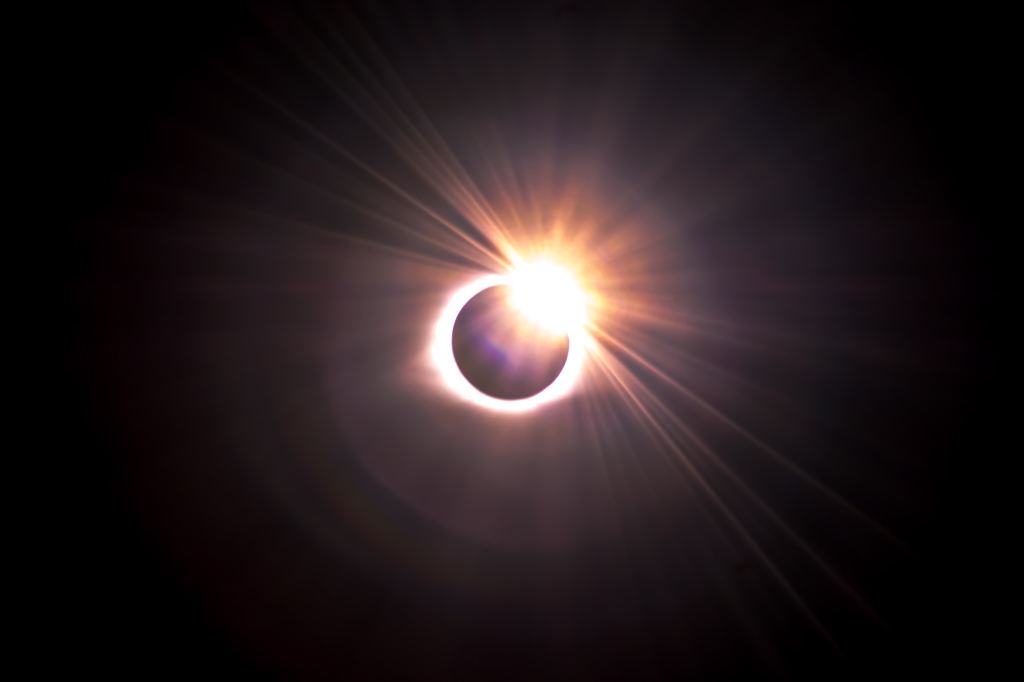
In April 2024, a total solar eclipse is set to occur. During this event, the Moon will briefly block out the sun’s light as it passes between the Sun and Earth. This captivating celestial event will last for 4 minutes and 28.13 seconds.
The best locations to witness this astronomical spectacle will be in Mexico, the United States, and Canada, where viewers will be treated to the most stunning views. In Western Europe and Central American countries, the eclipse will be visible partially.
October 2024 is expected to bring an unusual annular solar eclipse. At this time, the Moon will again traverse between the Earth and the Sun but will not completely obscure the Sun due to its position.
This October eclipse, lasting 7 minutes and 25 seconds, will be fully visible from Argentina and Chile, while other regions will only see a partial eclipse.



 tea party on the moon
Leave a comment