
How retrograde Venus influences love and relationships, Mars changes our energy and motivation, Saturn reveals karmic lessons, and Jupiter encourages us to reconsider our goals, beliefs, and life direction.
Mercury retrograde may be the most famous astrological phenomenon, but it is certainly not the only planetary retrograde that captures the attention of astrologers. Throughout the year, several planets appear to move backward through the zodiac, each bringing its own symbolic themes, emotional experiences, and opportunities for personal growth. While Mercury retrograde is traditionally associated with communication, travel, and technology, the retrograde movements of Venus, Mars, Saturn, and Jupiter are connected with deeper areas of human life, including love, ambition, responsibility, spiritual development, and our understanding of success.
In astrology, retrograde periods are often interpreted as invitations to slow down and examine aspects of life that have been developing almost automatically. Relationships that once seemed stable may suddenly require more attention, ambitions that once inspired us may lose their appeal, and long-standing beliefs may no longer reflect the people we have become. These experiences are not necessarily negative. On the contrary, retrograde cycles are traditionally associated with reflection, revision, and the opportunity to approach familiar situations with greater awareness.
An important distinction is that planets do not physically reverse their orbital direction during retrograde motion. Their backward movement is an optical effect observed from Earth, caused by the relative positions and speeds of the planets. Astrology gives this astronomical phenomenon symbolic meaning, although scientific evidence does not establish that planetary retrogrades directly cause changes in emotions, relationships, or life events.
Understanding the traditional meanings of different retrograde planets can nevertheless provide an interesting framework for self-reflection. Venus asks us to reconsider what love and happiness truly mean, Mars invites us to examine how we use our energy, Saturn encourages responsibility and maturity, and Jupiter challenges us to rethink our beliefs and aspirations. Together, these planetary cycles represent four different approaches to personal transformation.
In traditional astrology, each retrograde planet represents a different area of inner reflection and growth.
What Does It Mean When a Planet Is Retrograde?
Before exploring each planet individually, it helps to understand how retrograde motion is interpreted in astrology. Under ordinary circumstances, planets appear to move through the zodiac in their usual forward direction. During a retrograde period, a planet seems to slow down, stop briefly, and begin traveling backward against the background of the stars. Eventually, it appears to stop again and resume its normal forward motion.
Astrologers refer to these turning points as stations. A planet is said to station retrograde when its apparent backward movement begins and station direct when that movement ends. Traditional astrological interpretations often give special attention to these moments because they symbolize transitions between outward movement and inward reflection.
Retrograde periods are also connected with the concept of revisiting unfinished business. A relationship issue may return after months of silence, an abandoned project may suddenly seem interesting again, or an old ambition may become relevant under completely different circumstances. In astrological symbolism, such experiences are not necessarily viewed as coincidences or punishments. They represent opportunities to reconsider earlier choices and understand how our priorities have changed.
However, the significance of a retrograde depends heavily on the planet involved. Personal planets such as Venus and Mars are traditionally associated with relatively immediate experiences, including attraction, desire, emotional expression, and motivation. Social planets such as Jupiter and Saturn move more slowly and are connected with broader developmental themes, including belief systems, responsibility, long-term plans, and the structures that shape our lives.
Why Some Retrogrades Feel More Personal Than Others
Not every retrograde is interpreted as equally important for every individual. Astrologers examine the zodiac sign through which a planet is moving, the house it occupies in a person’s birth chart, and the aspects it forms with natal planets. Someone whose natal Venus is strongly activated during a Venus retrograde, for example, may use that period to examine relationship patterns more closely, while another person may focus primarily on finances, beauty, or personal values.
The duration of a retrograde also matters within traditional interpretation. Venus retrograde generally lasts around six weeks, while Mars retrograde can extend for approximately two to two and a half months. Jupiter and Saturn remain retrograde for roughly four to five months each year, giving their symbolism a slower and more sustained quality.
These differences help explain why astrologers associate Venus and Mars retrogrades with more concentrated periods of reassessment, while Jupiter and Saturn retrogrades are often understood as longer chapters of psychological and spiritual development.
Venus Retrograde: Love, Relationships, Beauty, and Self-Worth

Among all planetary retrogrades, Venus retrograde holds a particularly powerful place in popular astrology because of its traditional association with love. Venus governs attraction, pleasure, beauty, harmony, affection, material values, and the ways we experience happiness. In relationships, it symbolizes what draws people together and what makes emotional or romantic connections feel meaningful.
When Venus appears to move backward, astrologers interpret this as a period when our understanding of love and personal value may come under closer examination. Feelings that were previously ignored can become more noticeable, old relationship patterns may demand attention, and people may begin questioning whether their romantic lives genuinely reflect their emotional needs.
Rather than symbolizing the disappearance of love, Venus retrograde is traditionally associated with a change in perspective. What once seemed attractive may begin to feel less important, while qualities previously overlooked may become essential. The desire for emotional security, honesty, reciprocity, and genuine compatibility may take precedence over excitement or superficial attraction.
How Venus Retrograde Influences Romantic Relationships
Venus retrograde is often described as a time of emotional reevaluation. Couples may find themselves discussing unresolved issues, revisiting earlier disagreements, or discovering that their expectations have changed. Sometimes these conversations involve practical concerns, such as money, shared responsibilities, or future commitments. At other times, the questions are much more personal: Do we feel appreciated? Are we expressing affection in ways that truly reach each other? Are we growing together or simply preserving familiar routines?
Astrologers traditionally associate Venus retrograde with the resurfacing of relationship dynamics that need greater understanding. A disagreement that seemed insignificant months earlier might reveal a larger issue involving boundaries, trust, or emotional availability. Similarly, someone who has consistently prioritized a partner’s happiness may begin recognizing the importance of their own desires.
For single people, Venus retrograde is sometimes interpreted as a period when romantic preferences begin to shift. Someone who previously sought intensity and excitement may become more interested in stability and emotional maturity. Another person may realize that their standards were shaped by outside expectations rather than authentic personal values. Such changes can influence the kinds of partners people choose and the relationships they hope to create.
This does not mean that relationships are destined to experience problems during Venus retrograde. Astrology offers a symbolic interpretation rather than a prediction of unavoidable events. Healthy communication, mutual respect, and realistic expectations remain far more important than planetary timing.
Why Ex-Partners Are Associated With Venus Retrograde
One of the most recognizable themes in modern astrology is the return of former romantic partners during Venus retrograde. Astrologers frequently describe this period as one in which old relationships, unfinished conversations, and emotional memories can become more prominent. A person may unexpectedly think about a former partner, encounter someone from their romantic past, or feel motivated to understand why a previous relationship ended.
The spiritual interpretation of these experiences often centers on emotional closure. Sometimes remembering a past relationship helps us recognize how much we have changed, while other memories reveal patterns that continue to influence our present choices. Nostalgia can also make familiar connections seem more appealing, particularly during periods of loneliness or personal uncertainty.
However, an ex-partner returning is not automatically evidence of destiny, a soulmate connection, or a relationship that must be restored. A renewed connection deserves the same careful consideration as any other romantic decision. The reasons for a previous separation, the behavior of both individuals, and the presence of genuine change matter much more than the astrological period in which contact occurs.
Within Venus retrograde symbolism, an old relationship may represent either an opportunity for a healthier new beginning or the recognition that certain chapters are better left in the past.
Venus Retrograde and Self-Love
Although romantic relationships receive most of the attention, Venus retrograde is also associated with our relationship with ourselves. Venus symbolizes pleasure, beauty, self-esteem, and the ability to receive affection. When these themes are examined inwardly, questions about personal worth and external validation often become especially meaningful.
Someone may notice that their confidence depends too heavily on compliments, romantic attention, professional recognition, or physical appearance. Another person may realize that they have neglected simple activities that once brought happiness. In this symbolic framework, Venus retrograde encourages a reconsideration of how we define beauty, comfort, satisfaction, and personal value.
Self-love does not necessarily involve dramatic changes or constant positive affirmations. It can mean developing healthier boundaries, allowing ourselves to rest, recognizing our accomplishments, and making decisions that respect our emotional needs. Venus retrograde offers a useful theme for examining whether our daily habits support genuine well-being or merely maintain appearances.
Beauty, Fashion, and Money During Venus Retrograde
Venus traditionally rules aesthetics, luxury, artistic preferences, and material possessions. For this reason, some astrologers recommend taking extra time before making major changes to one’s appearance or committing to expensive purchases during its retrograde period. Cosmetic procedures, dramatic hair transformations, luxury investments, and substantial wardrobe changes are often mentioned in these interpretations.
The underlying symbolism is not that such decisions will inevitably go wrong. Rather, Venus retrograde represents a time when tastes and priorities may be reconsidered. A style that seems appealing during one phase of life may feel less appropriate later, and an expensive purchase may reveal more about an emotional desire than a practical need.
Financially, the period can be used to examine spending habits, reconsider personal budgets, and reflect on the connection between money and happiness. Questions such as whether we spend to impress others, whether our purchases reflect our priorities, and whether our financial choices support our long-term comfort can be particularly useful.
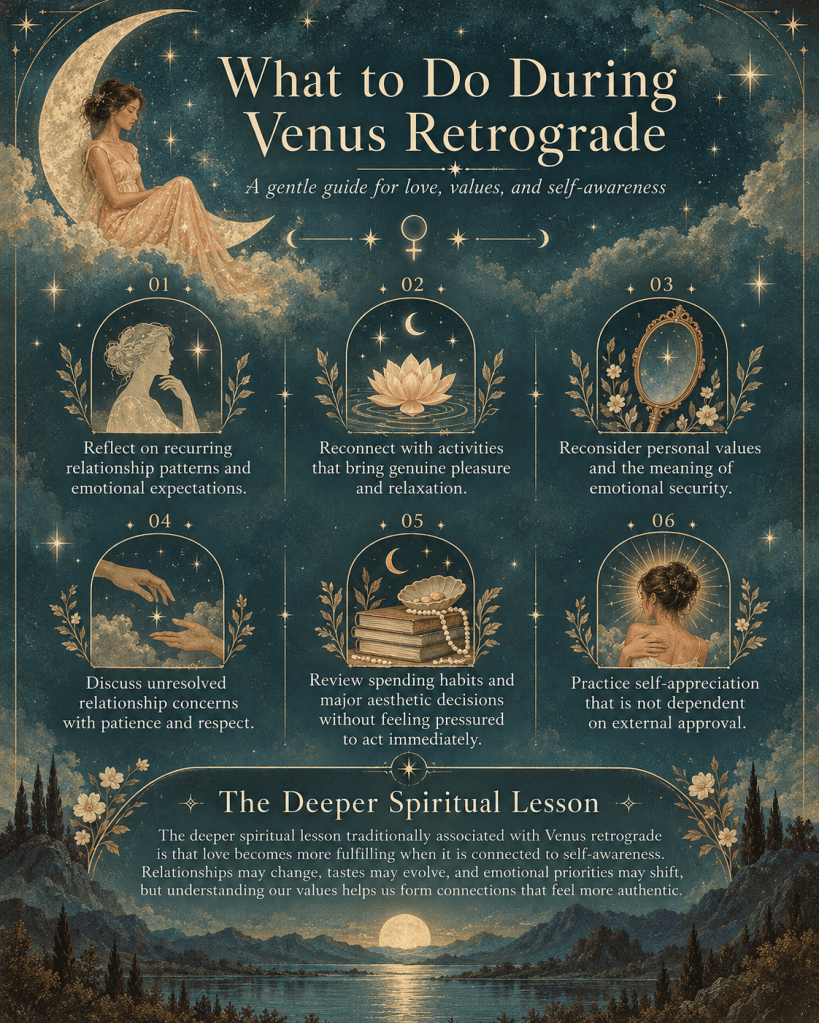
What to Do During Venus Retrograde
- Reflect on recurring relationship patterns and emotional expectations.
- Reconnect with activities that bring genuine pleasure and relaxation.
- Reconsider personal values and the meaning of emotional security.
- Discuss unresolved relationship concerns with patience and respect.
- Review spending habits and major aesthetic decisions without feeling pressured to act immediately.
- Practice self-appreciation that is not dependent on external approval.
The deeper spiritual lesson traditionally associated with Venus retrograde is that love becomes more fulfilling when it is connected to self-awareness. Relationships may change, tastes may evolve, and emotional priorities may shift, but understanding our values helps us form connections that feel more authentic.
Mars Retrograde: Energy, Motivation, Anger, and Personal Power
Mars represents an entirely different side of human experience. While Venus is associated with attraction and harmony, Mars symbolizes action, determination, courage, desire, competition, and the instinct to pursue what we want. In traditional astrology, Mars governs the way we assert ourselves, defend our boundaries, respond to challenges, and transform intention into movement.
When Mars turns retrograde, astrologers interpret this as a shift in how energy is directed. Instead of focusing primarily on external achievements, individuals may become more aware of their motivations, frustrations, and habits of action. This can be understood as a period for examining not only what we are pursuing but also why we feel compelled to pursue it.
Mars retrograde is sometimes described as challenging because modern life often rewards constant productivity. Ambition, efficiency, and forward progress are frequently treated as signs of success, making any perceived slowdown feel uncomfortable. Yet the symbolic purpose of Mars retrograde is not inactivity. It is the reconsideration of how personal energy is used and whether our efforts are aligned with meaningful goals.

Why Motivation May Feel Different During Mars Retrograde
One of the central themes of Mars retrograde is the reassessment of motivation. Activities that once generated excitement may begin to feel less rewarding, while long-standing projects can prompt questions about their purpose. In astrology, this is interpreted as an opportunity to distinguish authentic ambition from obligations, competitiveness, or expectations imposed by others.
A person who has spent years pursuing professional advancement may begin wondering whether that path still offers satisfaction. Someone dedicated to an intense fitness routine may decide to reconsider their approach to rest and recovery. Another individual may discover that they have been working toward a particular achievement simply because abandoning it would feel like failure.
These experiences can be interpreted through Mars retrograde symbolism without assuming that the planet causes them. Human motivation naturally fluctuates in response to stress, health, changing priorities, and life circumstances. The astrological framework provides a reflective way to examine those changes.
Mars Retrograde and Suppressed Anger
Mars is also associated with anger, conflict, and self-protection. While Venus emphasizes cooperation, Mars represents the ability to say no, defend personal boundaries, and confront situations that require direct action. Problems can develop when anger is consistently suppressed or expressed in ways that damage relationships.
During Mars retrograde, astrologers often focus on unresolved resentment and the difference between healthy assertiveness and aggression. Someone who avoids confrontation may recognize that silence has allowed dissatisfaction to accumulate. Another person who reacts quickly to disagreement may discover that their responses are influenced by earlier experiences rather than the immediate situation.
The lesson is not that anger should always be avoided. Anger is a normal human emotion that can reveal unfair treatment, crossed boundaries, or unmet needs. What matters is understanding its source and choosing a response that supports a constructive outcome.
Mars retrograde can therefore symbolize a period of learning how to express disagreement clearly, establish boundaries without hostility, and recognize when conflict is worth addressing.

Mars Retrograde in Love and Sexual Relationships
Mars has a strong connection with attraction, sexual desire, passion, and physical chemistry. While Venus represents affection and emotional enjoyment, Mars symbolizes the active expression of desire. During its retrograde period, astrologers sometimes expect themes involving intimacy, attraction, and the balance of initiative within relationships to become more noticeable.
Partners may reconsider differences in their needs, levels of affection, or expectations surrounding intimacy. Some individuals may become more aware of the relationship between physical attraction and emotional closeness, while others may reflect on whether their romantic choices are guided by genuine compatibility or temporary excitement.
Mars is also associated with the pursuit of romantic interests. Its retrograde symbolism invites reflection on the distinction between healthy initiative and the urge to control an outcome. Sometimes relationships develop more naturally when individuals communicate openly instead of treating affection as something that must be won.

Career, Competition, and Ambition During Mars Retrograde
In professional life, Mars symbolizes the energy needed to initiate projects, overcome obstacles, and compete for opportunities. During Mars retrograde, astrologers often recommend reviewing strategies rather than automatically increasing effort. This can be useful for anyone who has been working intensely without seeing the progress they expected.
A stalled project may benefit from a different approach, while a professional disagreement may reveal problems in communication or leadership. Ambitious individuals can use the period as a reminder that perseverance and flexibility are not opposites. Sometimes continuing toward a goal requires changing the method rather than abandoning the objective.
Mars retrograde is also associated with reconsidering the cost of competition. Comparing ourselves constantly with colleagues, friends, or public figures can create pressure that has little connection with personal fulfillment. Reflecting on what success means independently of other people’s achievements can help restore a healthier sense of purpose.
Mars Retrograde and Physical Energy
Traditional Mars symbolism includes physical vitality, movement, stamina, and exertion. This connection has led some astrologers to describe Mars retrograde as a period for reconsidering exercise routines, work schedules, and the balance between effort and recovery.
It is important not to interpret fatigue, pain, or changes in physical health as consequences of planetary motion. Such symptoms can have medical, psychological, or lifestyle causes and should be addressed appropriately. The useful reflective lesson is simply to pay attention to how activity, rest, and personal expectations interact.
Within this symbolic framework, Mars retrograde emphasizes sustainable effort. Energy becomes more useful when it is directed intentionally rather than spent on every possible task or conflict.
What to Do During Mars Retrograde
- Review goals that require significant time, energy, or personal sacrifice.
- Identify the situations that consistently trigger anger or frustration.
- Practice assertive communication and healthy boundaries.
- Reassess work habits, training routines, and recovery needs.
- Revisit unfinished projects with a clearer strategy.
- Reflect on the difference between genuine desire and pressure to succeed.
Mars retrograde is ultimately associated with the lesson that personal power is not measured only by speed, strength, or visible achievement. The ability to choose where to invest energy, recognize unproductive battles, and act from conscious intention is equally important.
Saturn Retrograde: Karma, Responsibility, Discipline, and Life Lessons
Saturn is one of the most significant planets in traditional astrology because of its connection with structure, discipline, time, responsibility, and the consequences of our choices. It symbolizes limitations, commitments, authority, patience, and the slow process through which experience develops into maturity.
Unlike the more immediate symbolism of Venus and Mars, Saturn is associated with long-term development. Its lessons frequently concern the structures we build around our lives: careers, relationships, financial obligations, daily habits, and personal responsibilities. In spiritual astrology, Saturn is also strongly connected with karma, though interpretations of karma vary between traditions.
When Saturn moves retrograde, astrologers describe a period of internal evaluation. Instead of encountering responsibility only through external demands, people are encouraged to consider their relationship with discipline, fear, achievement, and accountability.
Why Saturn Is Called the Planet of Karma
The word karma is often simplified in popular astrology to mean punishment for past actions, but this interpretation misses much of its philosophical complexity. In its broader religious and philosophical contexts, karma concerns action and its consequences, while modern spiritual astrology frequently uses the term to describe recurring lessons and patterns of behavior.
Saturn is called a karmic planet because it symbolizes the relationship between choices, responsibilities, and long-term outcomes. Avoiding difficult conversations may create relationship problems that eventually need attention. Ignoring financial responsibilities can lead to practical consequences, while consistently neglecting personal boundaries can reinforce unhealthy dynamics.
In this interpretation, Saturn does not need to punish anyone. The consequences of repeated behavior can themselves become opportunities for learning. A difficult experience may reveal which habits require change, which commitments are sustainable, and which expectations are unrealistic.
During Saturn retrograde, these themes are traditionally directed inward. The central question becomes whether we have genuinely learned from previous experiences or are continuing to repeat familiar patterns.
Saturn Retrograde and Unfinished Life Lessons
One of the strongest symbolic themes of Saturn retrograde is the return of unresolved responsibilities. These may involve professional commitments, financial planning, family obligations, boundaries, or long-term personal goals. Situations that have been postponed can become relevant again, encouraging a more deliberate response.
For example, someone may realize that a demanding career has gradually consumed time once reserved for family or personal interests. Another individual may recognize that an important goal remains unfinished because of fear of failure rather than a lack of ability. Saturn’s symbolism encourages an honest examination of these patterns without reducing them to moral judgments.
The retrograde period can also be associated with reassessing the rules by which we live. Some rules provide stability and protection, while others originate from outdated expectations or childhood experiences. Saturn retrograde invites reflection on which forms of discipline genuinely support growth and which have become unnecessarily restrictive.
Saturn Retrograde and the Return of the Past
Because Saturn is connected with history, time, and consequences, astrologers sometimes interpret its retrograde movement as an opportunity to confront past decisions. Unlike Venus retrograde, which emphasizes emotional memories and relationships, Saturn retrograde is more closely associated with obligations, commitments, and the practical effects of earlier choices.
A person might reconsider an old professional decision, revisit a long-term family responsibility, or reflect on a promise that no longer fits their circumstances. Another may become aware of repeating patterns involving authority figures, fear of rejection, or the belief that personal worth depends entirely on achievement.
In spiritual interpretations, these recurring themes are sometimes called karmic cycles. A cycle is considered complete not when a particular person or circumstance disappears, but when an individual responds differently to a familiar challenge.
For example, someone who repeatedly accepts unreasonable demands may begin practicing healthier boundaries. Someone who has avoided responsibility may learn to approach commitments with greater consistency. These changes illustrate the psychological value of Saturn’s symbolism without requiring a belief in predetermined cosmic punishment.
Saturn Retrograde in Relationships
Saturn represents commitment, endurance, and the structures that allow relationships to remain stable over time. During its retrograde period, astrologers often emphasize questions about responsibility, emotional maturity, and the difference between loyalty and obligation.
Some relationships survive because both partners continue choosing each other through changing circumstances. Others persist because of fear, guilt, financial dependence, or reluctance to disrupt familiar routines. Saturn retrograde symbolizes the opportunity to examine these distinctions carefully.
The period may encourage conversations about future plans, shared responsibilities, family expectations, or boundaries. For people who have experienced difficult relationships, it can also be a time for reflecting on the lessons they want to carry forward.
An important principle in interpreting Saturn is that endurance alone does not make a relationship healthy. Commitment is meaningful when accompanied by respect, reciprocity, and personal safety.
Career and Financial Responsibility During Saturn Retrograde
Saturn traditionally governs professional structures, authority, long-term achievement, and the patience required to build something sustainable. Its retrograde movement is therefore often associated with reviewing career development, financial responsibilities, and the systems that support everyday life.
Rather than expecting immediate rewards, Saturn emphasizes gradual progress. A person may use this period to reconsider professional qualifications, organize financial obligations, strengthen work habits, or assess whether a long-term plan remains realistic.
Saturn’s symbolism also encourages separating discipline from self-punishment. Working responsibly does not require constant exhaustion, just as ambition does not require sacrificing every other aspect of life. Sustainable achievement depends on clear priorities, realistic expectations, and the ability to adjust when circumstances change.
Saturn Retrograde and Spiritual Maturity
On a deeper level, Saturn retrograde symbolizes the development of inner authority. Early in life, many beliefs about success, responsibility, and acceptable behavior are shaped by parents, teachers, institutions, and social expectations. Over time, maturity involves deciding which of those beliefs deserve to remain part of our lives.
Saturn retrograde can be understood as an invitation to examine our internal rules. Do we feel guilty whenever we rest? Do we fear disappointing others even when their expectations are unreasonable? Are we holding ourselves to standards that leave no room for mistakes?
Spiritual maturity, in this context, does not mean becoming perfect. It means developing the ability to take responsibility without excessive shame, maintain commitments without losing individuality, and learn from experience without remaining trapped in the past.
What to Do During Saturn Retrograde
- Review unfinished responsibilities and long-term commitments.
- Reflect on recurring life patterns and the choices that reinforce them.
- Reconsider boundaries involving work, family, and relationships.
- Examine personal beliefs about discipline, success, and failure.
- Organize practical matters that require patience and consistency.
- Recognize progress that may not yet have produced visible rewards.
The central lesson of Saturn retrograde is that freedom and responsibility can support one another. By accepting responsibility for what we can control and releasing unrealistic expectations, we create more stable foundations for future growth.
Jupiter Retrograde: Rethinking Goals, Beliefs, Success, and Spiritual Growth

Jupiter is traditionally known as the planet of expansion, opportunity, wisdom, abundance, and good fortune. In astrology, it symbolizes our desire to understand the world, develop meaningful beliefs, pursue opportunities, and imagine possibilities beyond our immediate circumstances. Jupiter is also associated with education, philosophy, travel, religion, generosity, and the search for purpose.
When Jupiter moves retrograde, astrologers interpret its expansive energy as turning inward. Rather than focusing exclusively on external opportunities, achievements, or new experiences, individuals are invited to reconsider what growth actually means to them. Goals that once represented success may no longer provide satisfaction, while previously neglected interests may become more important.
Jupiter retrograde is particularly associated with questions about meaning. Are we pursuing a particular future because it reflects our genuine aspirations, or because society has taught us to value certain accomplishments? Have our beliefs evolved through experience, or are we holding onto ideas that no longer make sense?
Unlike a sudden emotional reassessment, Jupiter retrograde is often understood as a gradual revision of personal philosophy.
Jupiter Retrograde and the Meaning of Success
In everyday life, success is frequently measured through visible achievements such as income, professional recognition, possessions, academic qualifications, or social status. Jupiter symbolizes growth and prosperity, but its retrograde period is traditionally associated with questioning whether those external measures reflect deeper fulfillment.
Someone may achieve a professional milestone only to discover that their ambitions have changed. Another person may reconsider an expensive lifestyle after realizing that flexibility and free time are more important than material status. Others may redefine success through education, creative development, family relationships, or personal independence.
Jupiter retrograde encourages a broader understanding of prosperity. Material stability is important, but satisfaction can also emerge from meaningful work, supportive relationships, opportunities to learn, and a sense of belonging.
The symbolism of this period does not suggest that ambition should disappear. It encourages ambition to become more intentional.

Reconsidering Long-Term Goals During Jupiter Retrograde
Because Jupiter is associated with possibilities and future-oriented thinking, its retrograde movement often symbolizes the reassessment of plans that once seemed exciting. These might involve education, relocation, business expansion, spiritual development, or major changes in lifestyle.
A goal can remain meaningful while the path toward it changes. Someone who once dreamed of living abroad may discover that their priorities now involve family stability or professional freedom. Another individual may return to an abandoned field of study with a more mature understanding of its value.
Jupiter retrograde invites us to distinguish between changing direction and giving up. There is a significant difference between abandoning a dream out of fear and consciously choosing a new dream because our understanding of happiness has evolved.
Jupiter Retrograde and Spiritual Beliefs
Jupiter has long been associated with philosophy, religion, moral principles, and the search for truth. In spiritual astrology, its retrograde period is therefore considered especially meaningful for people who are reconsidering their beliefs or developing a more personal understanding of spirituality.
Sometimes spiritual development begins with curiosity about unfamiliar traditions. At other times, it involves questioning teachings that were accepted without examination. Jupiter retrograde symbolizes the possibility of moving from inherited beliefs toward a more thoughtful worldview.
A person may revisit philosophical books, explore meditation, reconsider religious practices, or develop a new appreciation for the traditions of their family. Others may become more interested in the relationship between spirituality, psychology, ethics, and everyday behavior.
Importantly, questioning beliefs does not necessarily weaken them. Careful reflection can strengthen convictions that withstand examination, while allowing outdated assumptions to be replaced with more useful perspectives.

Jupiter Retrograde and Financial Abundance
Jupiter is traditionally connected with prosperity, optimism, generosity, and expansion. During its retrograde period, astrologers often interpret financial themes through the idea of reviewing opportunities rather than automatically pursuing growth.
Someone may reconsider a business expansion, evaluate financial goals, or reflect on whether increased income is being accompanied by improved quality of life. Jupiter’s association with optimism can also provide a useful reminder to distinguish confidence from overconfidence.
The practical lesson is to examine opportunities carefully, consider long-term consequences, and avoid assuming that bigger is always better. Financial decisions should be based on reliable information and individual circumstances rather than planetary positions.
Within spiritual astrology, Jupiter retrograde also raises questions about abundance beyond money. Gratitude, knowledge, freedom, generosity, and meaningful relationships may all contribute to a sense of prosperity.
Jupiter Retrograde and Education, Travel, and Personal Discovery
Jupiter’s traditional symbolism includes higher education, international experiences, cultural exchange, and exploration. Its retrograde movement is often associated with reconsidering what we want to learn and how we hope to broaden our horizons.
Someone may return to a language they studied years earlier, revisit an unfinished educational program, or reconsider the purpose of a long-planned journey. A traveler may become less interested in collecting destinations and more interested in understanding the history, people, and traditions of a place.
Jupiter retrograde emphasizes the difference between accumulating experiences and integrating their lessons. Growth does not always require going somewhere new. Sometimes it begins by examining what previous experiences have already taught us.
What to Do During Jupiter Retrograde
- Reassess long-term goals and the meaning of personal success.
- Revisit educational interests or unfinished learning projects.
- Examine beliefs that may no longer reflect current experience.
- Review plans for expansion, travel, or major financial commitments.
- Reflect on the balance between ambition and contentment.
- Explore spiritual or philosophical questions with curiosity and discernment.
Jupiter retrograde is traditionally associated with the understanding that genuine expansion begins internally. Before pursuing a larger life, we may need to become clearer about what makes that life meaningful.
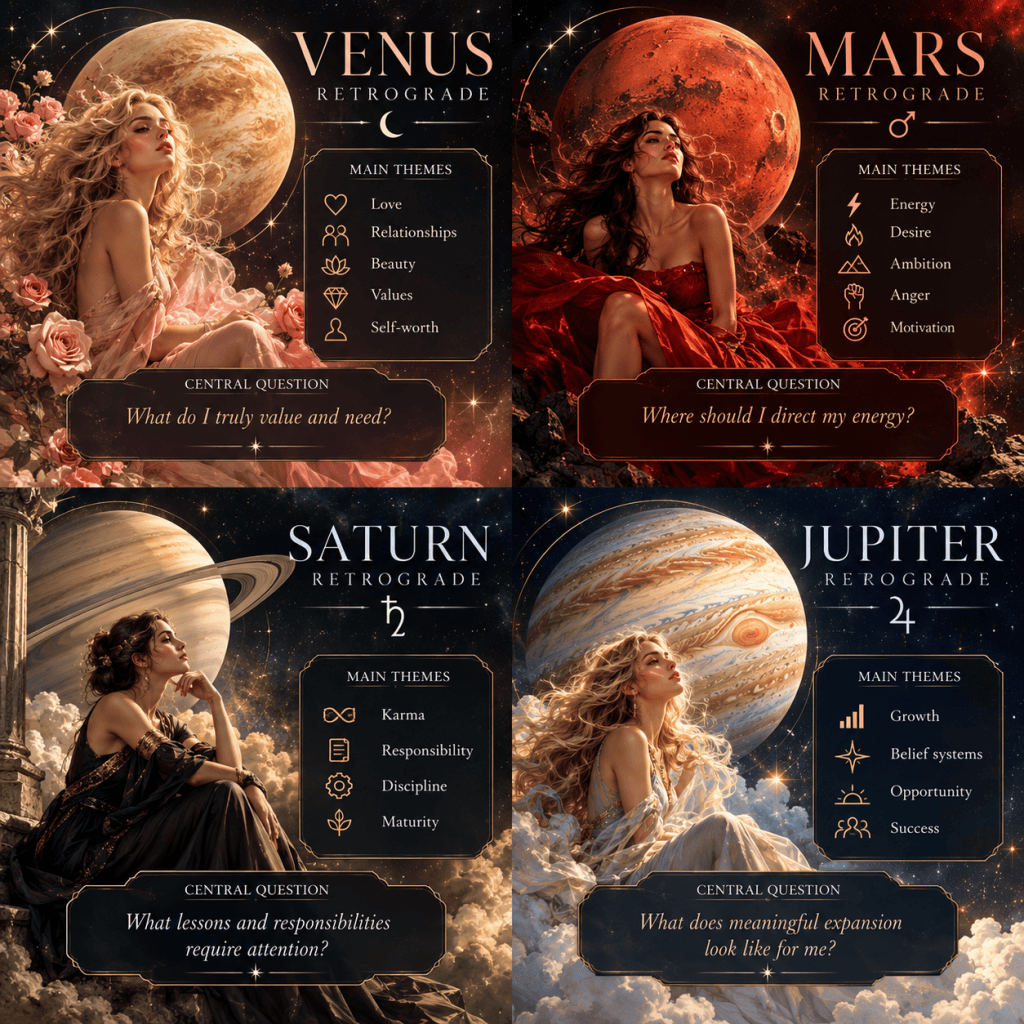
Venus, Mars, Saturn, and Jupiter Retrograde: The Main Differences
Although every retrograde period is associated with reflection, the four planets emphasize different aspects of experience.
| Planet | Main themes | Central question |
|---|---|---|
| Venus | Love, relationships, beauty, values, self-worth | What do I truly value and need? |
| Mars | Energy, desire, ambition, anger, motivation | Where should I direct my energy? |
| Saturn | Karma, responsibility, discipline, maturity | What lessons and responsibilities require attention? |
| Jupiter | Growth, belief systems, opportunity, success | What does meaningful expansion look like for me? |
These distinctions are particularly useful when more than one planet is retrograde at the same time. Multiple retrogrades do not necessarily indicate greater danger or more difficult circumstances. In astrological interpretation, they simply represent different symbolic areas that can be examined simultaneously.
For example, someone reflecting on relationship expectations during Venus retrograde may also be reconsidering career ambitions under Mars retrograde symbolism. Saturn may encourage them to examine the responsibilities that shape their choices, while Jupiter provides a framework for questioning whether those choices support their long-term vision.
What Happens When Several Planets Are Retrograde at Once?
It is common for several planets to appear retrograde simultaneously, especially because the outer planets spend substantial portions of the year in apparent backward motion. Popular astrology sometimes describes these periods as overwhelming, but multiple retrogrades are normal astronomical occurrences rather than unusual cosmic emergencies.
Astrologers generally interpret a concentration of retrograde planets as a period when reflection, revision, and unfinished matters become prominent themes. The particular symbolism depends on which planets are involved, their zodiac signs, and their positions in a person’s natal chart.
Venus and Mars Retrograde Together
Venus and Mars represent complementary aspects of attraction, desire, and relationships. Venus is associated with affection, pleasure, and harmony, while Mars symbolizes passion, initiative, and personal boundaries. If both planets are retrograde simultaneously, astrologers may interpret the combination as an invitation to examine the balance between receiving and pursuing love.
This symbolism can be applied to questions involving emotional needs, physical attraction, personal independence, and mutual respect. It encourages people to consider whether their relationships provide enough space for both tenderness and individuality.
Saturn and Jupiter Retrograde Together
Saturn and Jupiter represent an interesting contrast. Jupiter encourages expansion and possibility, while Saturn emphasizes structure, discipline, and limitation. Together, their retrograde symbolism can be understood as a reassessment of how ambition and responsibility work together.
A person may have ambitious goals but need more realistic structures to achieve them. Another may discover that excessive caution has limited opportunities for personal development. The reflective task is to find a balance between optimism and practicality, recognizing that sustainable growth usually requires both.
Mars and Saturn Retrograde Together
Mars symbolizes action, while Saturn represents boundaries and long-term responsibility. Their combined retrograde symbolism invites reflection on patience, persistence, and the consequences of impulsive decisions.
This combination can be interpreted as a reminder that not every obstacle requires greater force. Some challenges benefit from improved planning, clearer boundaries, or a different understanding of what success requires.
Venus and Jupiter Retrograde Together
Venus and Jupiter are traditionally associated with pleasure, happiness, generosity, and abundance. When both are retrograde, astrologers may focus on how emotional fulfillment relates to personal values and broader life goals.
Someone may reconsider how much importance they place on possessions, social approval, or romantic attention. Another may explore whether generosity has become disconnected from personal boundaries. This combination symbolizes the difference between seeking more happiness externally and recognizing what already creates satisfaction.
How Retrograde Planets Affect the Zodiac Signs
In traditional astrology, planetary retrogrades are interpreted differently depending on the zodiac sign and astrological house in which they occur. The same Venus retrograde may emphasize romantic relationships for one person and financial values for another, depending on the structure of their natal chart.
General sun-sign interpretations can be entertaining and provide broad reflective themes, but they are less personalized than a complete birth-chart analysis. Astrologers often pay particular attention to the rising sign, house placements, planetary rulers, and exact aspects between transiting and natal planets.
Even so, each zodiac sign has traditional associations that can help illustrate how retrograde themes might be approached.
Fire Signs: Aries, Leo, and Sagittarius
Fire signs are traditionally associated with enthusiasm, initiative, independence, and personal expression. Venus retrograde may provide a framework for examining the balance between romantic excitement and emotional stability, while Mars retrograde emphasizes the importance of directing ambition intentionally.
Saturn retrograde may encourage these signs to develop patience and sustainable habits, especially when immediate progress is not possible. Jupiter retrograde can inspire reflection on long-term aspirations, personal freedom, and the meaning of success.
For fire signs, the overarching lesson is that purposeful action can be more effective than constant movement.
Earth Signs: Taurus, Virgo, and Capricorn
Earth signs are associated with practicality, stability, reliability, and material security. Venus retrograde may raise questions about comfort, finances, relationship expectations, and personal values. Mars retrograde can symbolize a reconsideration of productivity, work habits, and the relationship between effort and achievement.
Saturn retrograde has particular thematic relevance to responsibility and structure, encouraging reflection on commitments and established routines. Jupiter retrograde may invite earth signs to consider opportunities that extend beyond familiar definitions of success.
For earth signs, retrograde symbolism emphasizes the importance of creating stability without becoming resistant to necessary change.
Air Signs: Gemini, Libra, and Aquarius
Air signs are traditionally linked with communication, ideas, relationships, and intellectual exploration. Venus retrograde may encourage reflection on compatibility, social connections, and the difference between emotional intimacy and intellectual attraction.
Mars retrograde may provide a useful theme for examining disagreement, competitive thinking, and the tendency to spend energy on too many projects. Saturn retrograde can encourage stronger boundaries and greater consistency, while Jupiter retrograde invites a deeper examination of personal beliefs and future possibilities.
For air signs, the central lesson is to connect ideas with meaningful action and emotional awareness.
Water Signs: Cancer, Scorpio, and Pisces
Water signs are associated with sensitivity, intuition, emotional depth, and imagination. Venus retrograde may symbolize the reconsideration of attachment patterns, relationship memories, and emotional security. Mars retrograde can encourage a healthier approach to anger, self-protection, and personal boundaries.
Saturn retrograde may highlight the importance of distinguishing responsibility from excessive emotional obligation. Jupiter retrograde can offer a framework for spiritual exploration, intuition, and the search for meaning.
For water signs, retrograde periods symbolically emphasize emotional understanding without losing practical perspective.
Retrograde Planets in the Birth Chart: Are They Different From Transiting Retrogrades?
One important distinction in astrology is the difference between a planet that is retrograde at the moment of birth and a planet that becomes retrograde as part of its ongoing movement through the sky.
A natal retrograde planet is a planet that appeared to move backward when a person was born. In traditional and modern psychological astrology, this is sometimes interpreted as a more internalized or unconventional expression of the planet’s qualities. A transiting retrograde planet, by contrast, refers to a temporary period that occurs as planets continue moving through the zodiac.
These two ideas are related but not identical.
Natal Venus Retrograde
Astrologers sometimes associate natal Venus retrograde with a highly personal approach to love, beauty, and emotional attachment. Individuals with this placement may be described as taking more time to understand their relationship needs or developing values that differ from conventional expectations.
Rather than representing an inability to love, this placement is interpreted as an invitation to understand affection and self-worth through individual experience.
Natal Mars Retrograde
Natal Mars retrograde is sometimes associated with an inward or unconventional expression of ambition, anger, and personal drive. Astrological interpretations often emphasize the need to develop confidence in asserting oneself and finding productive ways to channel determination.
The symbolic challenge involves discovering how to act decisively without relying entirely on external pressure or approval.
Natal Saturn Retrograde
In modern astrology, natal Saturn retrograde is frequently interpreted through themes of internal authority, responsibility, and personal expectations. Some astrologers associate it with a tendency toward strict self-evaluation or a complicated relationship with rules and authority.
Its proposed lesson involves developing mature self-discipline while learning to distinguish personal responsibility from unnecessary guilt.
Natal Jupiter Retrograde
Natal Jupiter retrograde is often interpreted as a symbol of independent beliefs, internalized wisdom, and a personal search for meaning. Individuals with this placement may be described as questioning traditional definitions of success or preferring to discover their philosophical convictions through direct experience.
This interpretation emphasizes the development of a worldview that reflects genuine understanding rather than unquestioned acceptance.
None of these natal placements determines personality, relationship outcomes, or future events. They are symbolic interpretations used within astrology rather than scientifically established psychological characteristics.
Retrograde Shadows: Why Astrologers Look Beyond the Exact Retrograde Dates
A retrograde cycle involves more than the period during which a planet visibly appears to move backward. Astrologers also consider the pre-retrograde shadow and post-retrograde shadow, which refer to the planet moving through the same stretch of zodiacal degrees before and after its apparent reversal.
The pre-retrograde shadow begins when a planet first reaches the degree to which it will eventually return during the retrograde. The post-retrograde shadow ends when the planet moves forward beyond the degree where it originally stationed retrograde.
Symbolically, astrologers divide these phases into three stages.
The Pre-Retrograde Shadow: Recognizing a Theme
This phase is traditionally associated with the emergence of circumstances or questions that may later require reconsideration. A relationship issue, an important decision, or a long-term goal may become noticeable before the retrograde itself begins.
The astrological interpretation encourages observation rather than the assumption that a problem is inevitable.
The Retrograde Phase: Reflection and Revision
During the apparent backward movement, astrologers emphasize review, reconsideration, and adjustments. Themes that appeared earlier may be examined more deeply, while previously overlooked details may receive attention.
This phase symbolizes the opportunity to understand a situation from another perspective.
The Post-Retrograde Shadow: Integration and Forward Movement
Once the planet has stationed direct, the post-retrograde shadow symbolizes the application of what has been learned. In relationships, this might involve adopting healthier communication habits. In professional life, it could mean using revised strategies or approaching responsibilities with greater clarity.
The three-stage model provides a narrative of recognition, reflection, and integration, although the existence of a shadow period does not establish that specific life events will occur.
Are Retrograde Planets Connected With Karma and Destiny?
Spiritual astrology often associates retrograde planets with unfinished lessons, karmic relationships, and experiences that seem to repeat until something changes. This interpretation is especially common with Saturn, but Venus, Mars, and Jupiter can also be understood through the symbolism of recurring patterns.
Venus represents lessons about affection, values, and self-respect. Mars symbolizes the development of courage, self-control, and healthy assertiveness. Saturn emphasizes responsibility, maturity, and long-term consequences, while Jupiter relates to wisdom, faith, generosity, and the development of personal meaning.
From a spiritual perspective, a recurring experience may be viewed as an invitation to approach an old challenge differently. Someone who repeatedly enters emotionally unbalanced relationships might begin examining their boundaries and expectations. Another person who frequently abandons goals could explore whether fear, unrealistic standards, or changing interests contribute to that pattern.
These interpretations can be meaningful as forms of self-examination, but it is important not to treat adversity as deserved punishment or evidence of an unavoidable karmic debt. Difficult circumstances can arise from factors far beyond personal choices, and spiritual beliefs should never be used to excuse mistreatment or blame people for suffering.
A constructive approach to karmic astrology focuses on agency, reflection, and the possibility of choosing healthier responses.
What Should You Avoid During Retrograde Periods?
Popular astrology frequently circulates strict rules about retrograde planets, including warnings against starting relationships, signing contracts, launching businesses, changing jobs, or making important purchases. Such advice can create unnecessary anxiety, especially because several planets may be retrograde simultaneously.
There is no scientific reason to assume that these activities become inherently dangerous because of planetary motion. Astrological retrogrades are more useful as symbolic reminders to approach major decisions thoughtfully.
For those who enjoy following astrological traditions, the following themes are commonly associated with extra reflection:
- During Venus retrograde: Avoid rushing romantic commitments or major aesthetic decisions without considering personal values and long-term consequences.
- During Mars retrograde: Be mindful of impulsive conflicts, unsustainable workloads, and decisions motivated primarily by anger or competition.
- During Saturn retrograde: Address responsibilities directly rather than allowing unresolved obligations to accumulate.
- During Jupiter retrograde: Examine assumptions before pursuing expansion, major investments, or goals based solely on external expectations.
The distinction between caution and fear is important. A meaningful opportunity does not need to be rejected simply because a planet is retrograde. Practical timing, preparation, mutual consent, financial considerations, and individual circumstances should guide important decisions.
How to Use Retrograde Energy for Personal and Spiritual Growth
Astrology can be approached as a reflective practice rather than a system that determines what must happen next. From this perspective, retrograde periods become useful occasions to consider questions that may otherwise be overlooked in the demands of everyday life.
Journaling is one way to explore these themes. During Venus retrograde, writing about emotional needs and relationship expectations can provide clarity. During Mars retrograde, examining motivation and sources of frustration may reveal how energy is being spent. Saturn retrograde can inspire reflection on long-term commitments and recurring responsibilities, while Jupiter retrograde provides an opportunity to reconsider beliefs, goals, and the meaning of fulfillment.
Mindfulness, meditation, creative activities, and thoughtful conversations may also support reflection. These practices need not be tied to a particular planetary period to be beneficial. Their value comes from the attention and intention individuals bring to them.
Four Reflection Questions for the Four Planets
Venus — The Heart
What am I accepting in love, and does it reflect how I value myself?
Mars — The Will
Am I using my energy to pursue meaningful goals or to satisfy pressure and expectations?
Saturn — The Teacher
Which recurring responsibility or life pattern requires a more mature response?
Jupiter — The Seeker
Do my current goals reflect what genuinely gives my life meaning?
Frequently Asked Questions About Retrograde Planets
Is Venus retrograde bad for love?
Not necessarily. In astrology, Venus retrograde is associated with reflecting on relationships, emotional needs, and personal values. It does not mean that every relationship will experience conflict or that a new romance is destined to fail. Healthy relationships depend on communication, trust, compatibility, and mutual effort.
Does Mars retrograde cause tiredness or anger?
There is no established scientific evidence that Mars retrograde causes changes in energy, mood, or physical health. In astrological symbolism, Mars represents vitality, desire, and assertiveness, making its retrograde period a traditional time to reflect on motivation and how anger is expressed.
Does Saturn retrograde bring karmic punishment?
Saturn retrograde is often described through karmic language, but it should not be understood as proof of punishment. Within spiritual astrology, Saturn represents responsibility, recurring lessons, and long-term consequences. A more constructive interpretation focuses on maturity and learning rather than fear.
Is Jupiter retrograde unlucky?
Jupiter retrograde is not inherently unlucky. Traditional astrology associates Jupiter with expansion and abundance, while its retrograde movement symbolizes reconsidering goals, beliefs, and opportunities. It can be understood as a period for evaluating the direction of growth rather than predicting misfortune.
Can you start a relationship during Venus retrograde?
Yes. There is no scientific basis for avoiding a relationship solely because Venus is retrograde. People who follow astrology may choose to reflect more carefully on compatibility, expectations, and emotional readiness, but these considerations are useful at any time.
Is it normal for several planets to be retrograde at once?
Yes. Multiple simultaneous retrogrades occur regularly because different planets have different orbital periods and apparent motion patterns. In particular, Jupiter and Saturn spend several months retrograde each year. Their overlapping retrograde periods are not unusual astronomical events.
Which retrograde is the most powerful?
Astrology does not provide one universally accepted answer. Venus and Mars retrogrades may receive attention because they occur less frequently than Mercury retrograde and are associated with personal themes. Saturn and Jupiter retrogrades are interpreted through longer developmental cycles. In natal astrology, the significance of a retrograde depends on individual chart placements and aspects.
Do retrograde planets bring people from the past back into our lives?
Popular astrology frequently associates retrogrades, especially Venus and Mercury, with reconnecting with people from the past. However, there is no reliable evidence that these planetary cycles cause former partners, friends, or acquaintances to return. Reconnection is better evaluated through human circumstances, choices, and intentions.
Final Thoughts: Retrograde Planets as Symbols of Inner Transformation
Venus, Mars, Saturn, and Jupiter represent four different but interconnected dimensions of human experience. Venus asks how we love and what we value, Mars reveals how we pursue our desires and protect our boundaries, Saturn encourages responsibility and maturity, and Jupiter inspires us to examine our beliefs and the future we hope to create.
Their retrograde periods are traditionally interpreted as opportunities to reconsider these areas of life from a deeper perspective. A change in romantic expectations may lead to stronger boundaries, a revision of professional ambitions may create space for healthier priorities, and the reevaluation of long-standing beliefs may open the door to personal growth.
Perhaps the most meaningful lesson of retrograde astrology is that progress does not always look like moving forward. Sometimes development involves returning to a familiar question with new experience, recognizing that a former ambition no longer fits, or understanding an old relationship in a more compassionate and realistic way.
The planets do not need to control our decisions for their symbolism to offer something worth contemplating. Whether viewed through a spiritual, psychological, or purely cultural lens, retrograde cycles remind us that reflection can be just as important as action.
And while Venus speaks the language of the heart, Mars the language of desire, Saturn the language of responsibility, and Jupiter the language of wisdom, all four ultimately point toward a similar idea: meaningful growth begins when we become more conscious of the lives we are choosing to create.




Leave a Reply